.svg)
A practical classroom activity that turns Downtown Cairo's signs, shopfronts, and public language into a tool for deeper Arabic learning.



In “Learning Arabic from Cairo's Streets”, I wrote about Cairo as an “open textbook” for Arabic learners. The idea is simple: once you step outside the classroom, Arabic is everywhere. It is on shop windows, street signs, billboards, graffiti, menus, government buildings, and handwritten notes. That public language is the city's linguistic landscape (LL)Linguistic LandscapeThe language we meet in public space: street signs, shop names, billboards, graffiti, menus, institutional notices, and more..
This article takes that idea one step further. What if students did not just notice those signs casually, but learned how to investigate them? What if a walk through Downtown Cairo could become a structured activity that helps learners read language, culture, identity, and place at the same time?
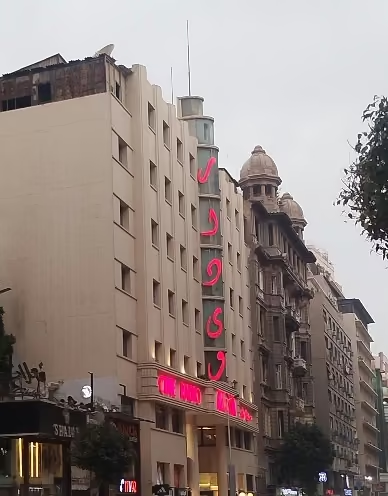
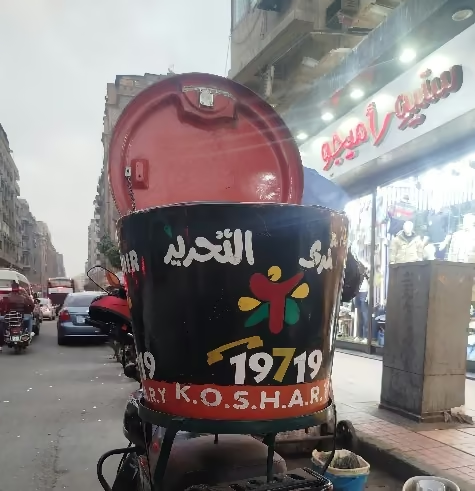
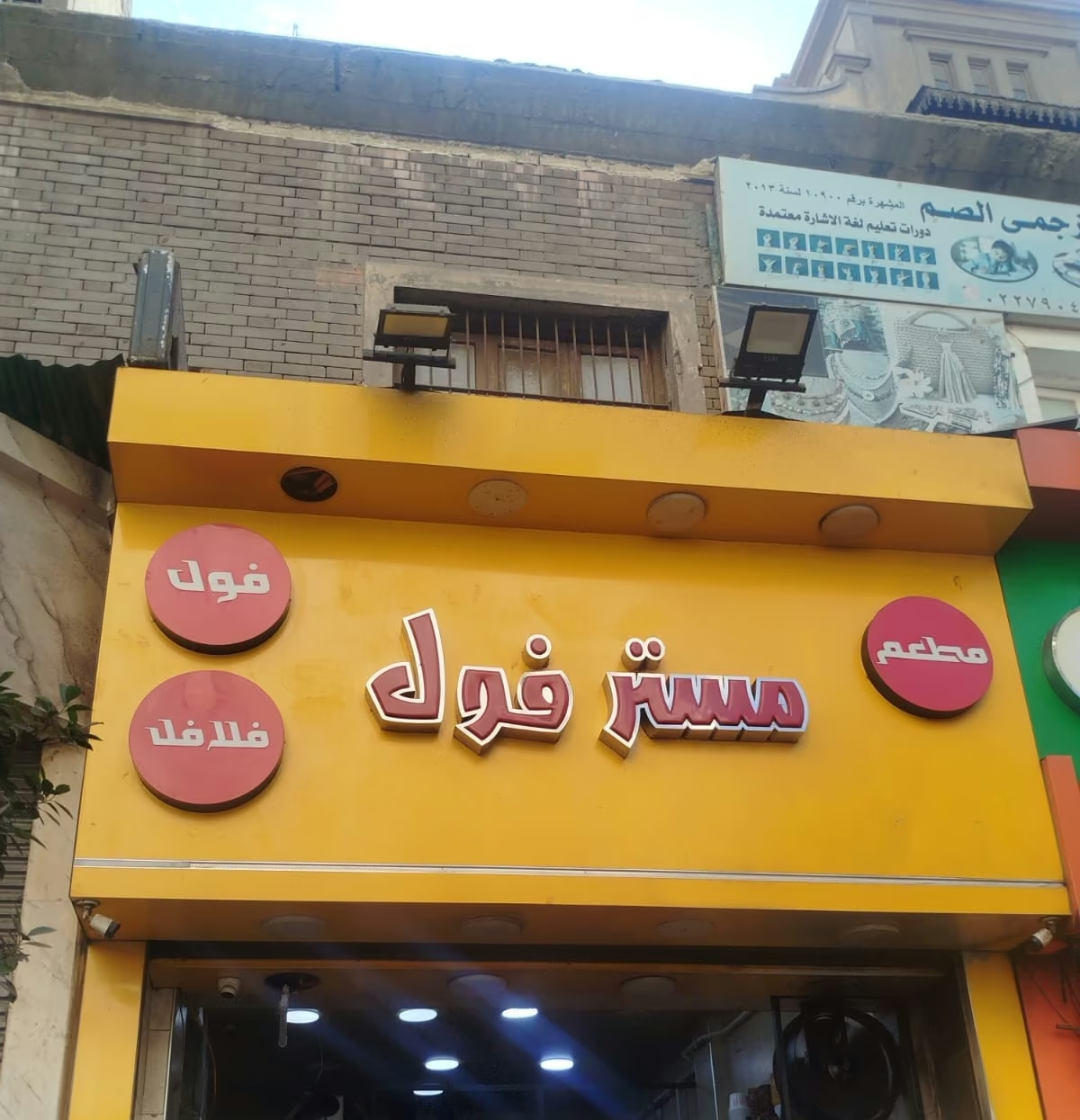
Figure 1: LL items in Downtown Cairo
Study abroad programs often measure progress through speaking: more fluency, more interaction with native speakers, more confidence in conversation. All of that matters. But language learning abroad can be bigger than speaking alone.
When learners pay attention to the signs around them, they start building intercultural communicative competence (ICC)Intercultural Communicative CompetenceThe mix of curiosity, knowledge, interpretation skills, and critical awareness that helps learners communicate across cultures.. They learn to ask better questions: Why this word here? Why this variety of Arabic? Who is being addressed? What does the visual design add? What social meaning is hiding in plain sight?
To explore those questions, I designed an activity based on Downtown Cairo's linguistic landscape. The goal is to move students from passive exposure to active meaning-making. They are no longer only students walking through the city; they become researchers learning how to observe, document, ask, and interpret.
The activity was designed for the course “Teaching Culture,” taught by Dr. Raghda El-Essawi in the TAFL Master's program at the American University in Cairo. It is meant for advanced learners of Egyptian Colloquial Arabic in Egypt, but the format can be adapted for different levels, cities, and learning contexts.
At the center of the activity is an ethnographic approachEthnographyA way of learning by observing people, places, habits, and meaning in context before rushing to explain them.. Students are invited to slow down, look closely, and treat the city as something to be read. Instead of jumping straight to translation, they begin by asking what a sign is doing in its specific place.
This shift matters. It positions learners as “linguistic ethnographers”: people who explore language as part of everyday life, not as a closed system inside a textbook.
The activity begins with a camera walkCamera WalkA guided walk where students photograph signs, then use the images as material for language and culture analysis. through Downtown Cairo. Students walk through the area and photograph signs that catch their attention: shop names, advertisements, street signs, institutional notices, graffiti, posters, or anything else that feels linguistically or visually interesting.
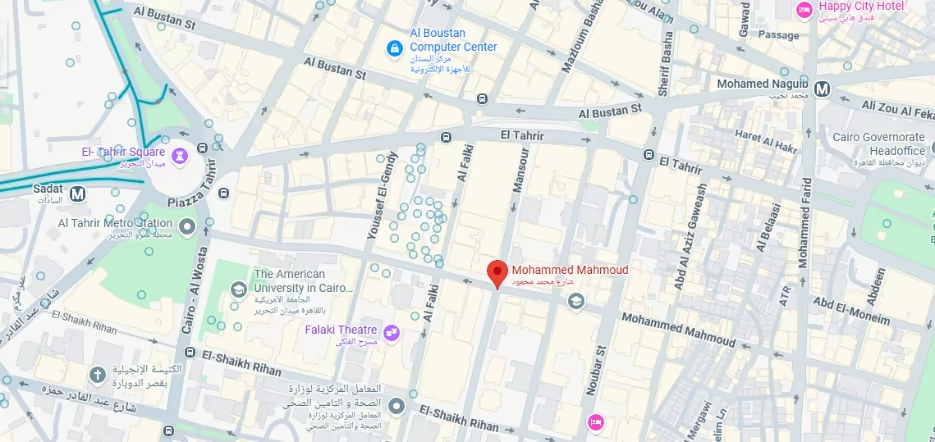
Figure 2: Downtown Cairo area
The first task is not to analyze immediately. It is to observe carefully. Where is the sign? What does it look like? Which language varieties appear? Is there Arabic, English, or another language? Is the Arabic formal, colloquial, playful, institutional, commercial, or mixed?
At home, students choose examples from their photos and organize their observations using a simplified version of Hymes' SPEAKING framework. In practice, the framework becomes a set of guiding questions:
| Component | Guiding Questions |
|---|---|
| Setting | Where is the sign located? |
| Participants | Who created the sign? Who is the intended audience? |
| Ends | What is the sign trying to do? |
| Act sequence | What message is being delivered, and how is it organized? |
| Key | What tone, style, or register does it use? |
| Instrumentalities | Which languages, scripts, images, colors, or symbols appear? |
| Norms | What social or cultural expectations shape the sign? |
| Genre | Is it a shop sign, advertisement, institutional notice, graffiti, or something else? |
The point is not to make students memorize a model. The point is to give them a practical lens. With that lens, a sign stops being a flat object and becomes a clue: about audience, class, identity, power, humor, commerce, formality, and belonging.
On the second day, students bring their photos and findings back to the classroom. They present what they noticed, compare examples, and discuss patterns across the signs they collected.
This is where the activity becomes collaborative. Students begin to see that one sign may point to language choice, another to social class, another to global branding, another to Egyptian Colloquial Arabic in public writing, and another to who is included or excluded by a message.
The final product is a shared visual poster that combines photos with short analyses. It gives the class something concrete to build together, while keeping the learning connected to real places they walked through themselves.
The activity supports intercultural learning in several ways. It gives students real-world material and asks them to interpret it with curiosity instead of quick judgment.
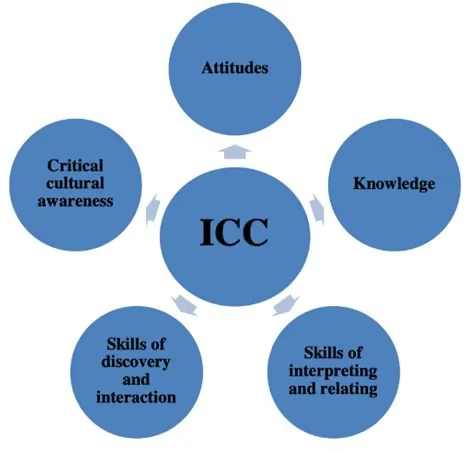
Figure 3: A model of ICC
That practice of noticingNoticingThe moment learners consciously pay attention to language in real life, turning background input into something they can learn from. is important: it turns language in the background into language students can actually learn from.
It also opens space for more critical questions:
These are not side questions. They are part of what it means to understand language as a living social practice.
One of the richest parts of Cairo's linguistic landscape is that signs are rarely only about words. They are multimodalMultimodalityMeaning made through several resources at once: words, images, color, layout, script, space, and material context.. A sign may combine Arabic, English, images, color, typography, script choices, placement, and neighborhood context.
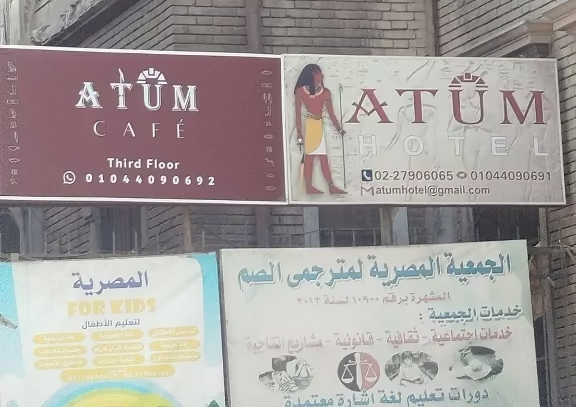
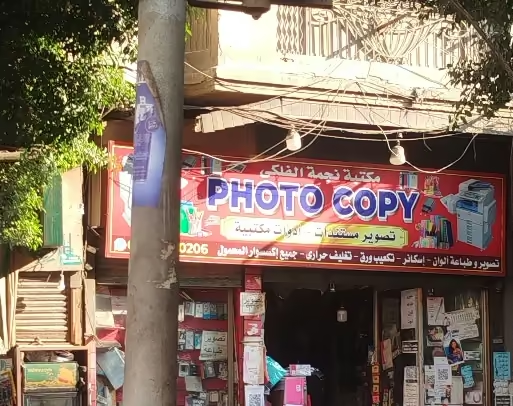
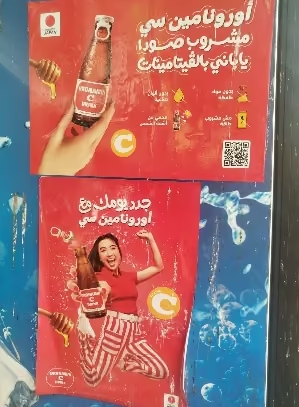
Figure 4: Multimodal signs in Downtown Cairo
For learners, this expands the idea of language learning. A shop sign is not just vocabulary practice. It can also teach tone, audience, humor, prestige, visual culture, and how different communities position themselves in public space.
In this sense, Cairo's streets offer more than new words. They offer a way to understand how language is lived.
Language learning abroad is often described as interaction with people. But learners also interact with places.
By learning to read the city, students strengthen their Arabic while also developing a deeper sense of the sociocultural world in which Arabic is used. They begin to see signs as evidence, public space as a classroom, and everyday encounters as material for learning.
This kind of activity can help study abroad programs:
In Cairo, the streets speak. The opportunity for language educators is to help students listen more closely, ask better questions, and turn ordinary walks into moments of discovery.
With a background in journalism and Mediterranean studies, Veronica has written on language, culture, and society for platforms such as The New Arab, Egyptian Streets, Dialoghi Mediterranei, and Beirut Today, and is the author of Sorprendersi in Egitto (Bookabook, 2023), a book reflecting on her linguistic and cultural journey in Egypt. Across her work in journalism, communication, and education throughout the Mediterranean, Arabic has remained a central focus, leading her to pursue further specializations, including the CASA@AUC program (2023–2024) and a TAFL diploma from Alexandria University. She is currently a TAFL MA graduate fellow at the American University in Cairo and has recently served in credit curriculum facilitation at Al-Wāḥa Arabic Camp (Concordia Language Villages). Alongside this, she continues to explore Arabic through cultural storytelling and everyday practice, sharing this work through her project and Instagram page, where language meets daily life and culture.