.svg)
This blog post explores the challenges Arabic polyglossia poses for community interpreters, highlighting the difficulties in cross-dialectal communication and advocating for better training resources like the Aralects project to bridge these linguistic gaps.


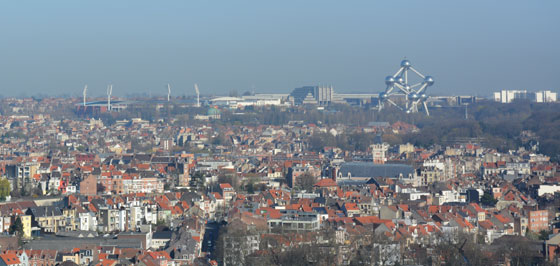
Brussels, autumn 2018. I’m working as an intern for one of the associations providing public service interpreting in the Belgian capital. It’s a medical appointment, and I’m translating between the doctor and a lady from Morocco. I mainly express myself in Levantine Arabic (I had spent some time in Palestine, Jordan and Lebanon), and have passive knowledge of fuṣḥāfuṣḥāModern Standard Arabic, which I learned at university during my Translation degree. Yet we struggle to understand each other, and not just me, but she too.
After a few turns and attempts, I end up asking her ¿Hablas español? Turns out that she had lived a few years in Spain. We did the rest of the appointment in Spanish, not resorting to Arabic anymore.
This anecdote goes back to the very beginning of my experience as a community interpreter. Of course, each case is particular, and it is not meant to be generalized. However, I like this anecdote because it breaks a certain number of myths, such as the idea that Standard Arabic serves as a vehicular language or the idea that all MaghrebiMaghrebiSpoken across Morocco, Algeria, Tunisia, Libya, and Mauritania — this group of dialects has strong Amazigh, French, and Andalusian influences, making it quite distinct from Eastern varieties. speakers understand Eastern dialectsEaster DialectsIncludes Egyptian, Levantine, Gulf, and Iraqi dialects. These are generally more mutually intelligible with one another than with Maghrebi Arabic..
My name is Juliette, and I started to learn Arabic in 2012. I did a degree in Arabic-English translation, and then started working as a community interpreter and in the field of literacy. During and after my studies in Translation, I was always obsessed with one question: why does nobody talk about dialects?
It really appeared to me as the elephant in the room, yet it was not really a topic, neither in the classroom nor amongst my colleagues. If you landed on this blog, you are probably familiar with the idea of diglossia, or at least you have an idea of the linguistic challenges Arabic poses. Simply put, it is the idea that Arabic is not a single language but has (at least) two varietiesDiglossiaWhen a language has one “high”, written, standardized, used in formal context) and one “low”, spoken, subject to much more variation, and used in rather informal contexts.. Actually, you don’t need to have a PhD in linguistics to realize that reality is more complex and nuanced: this is why the idea of poly- or pluri-glossia is now increasingly used to describe the reality of the Arabic language, as it allows for seeing it as a continuum between dialectal and a more or less formal standard varieties, with many intermediate forms in between.

Don’t get me wrong, every language has its difficulties, and the challenge of mastering different oral and written codes and registers is not peculiar to Arabic. Nevertheless, this polyglossia creates difficulties for both learners and professionals. It is an immense challenge for learners of course — Katie’s anecdote in Shakespeare on the Street: Standard Arabic and Choosing a Dialect illustrates this challenge and is probably very relatable for many non-natives who’ve lived similar moments at one point in their learning journey, but also for professionals, and not just to beginner interpreters as I was in that anecdote.
A couple of years after that encounter, I was speaking with a very skilled conference interpreter trained at the prestigious ESIT, in Paris, who had done simultaneous translation from French to Arabic during a congress I had just attended. When I told her about my working environment, she immediately told me she had done it for a while but had to stop, because of the issue of dialects. During one asylum interview, she had too much trouble understanding the person and had the professional honesty to just stop the interview. But how many dare to do that?
Another former teacher of mine in Jordan, also recalled the difficulties she faced when providing simultaneous translation to English, during a conference organized by an NGO where participants spoke different Arabic dialects. She speaks of a “double translation” :

كان علي أن أترجم من لهجاتهم إلى الفصحى، وبعد ذلك من الفصحى إلى الإنجليزية
I had to translate from their dialects into Standard Arabic, and then from Standard Arabic into English.
Public service interpreters, or community interpreters, work in very diverse settings: it can range from medical appointments and counseling sessions with lawyers, to administrative and welfare convocations and mental health consultation. This means the register and vocabulary can both be quite formal and technical or very spontaneous and colloquial, with little to no way of knowing in advance the exact content of the appointment.
They work with people of all ages and with all sorts of educational and personal backgrounds. This is therefore a role that demands not only linguistic and cultural knowledge, but also high interpersonal skills and ethical awareness. These settings as usually perceived as less critical or prestigious than translation and interpretation within political spheres, diplomacy or business, but the need for accuracy is as important.
Misunderstandings can lead to heavy consequences on people’s lives (legal errors, impact on stay permits or treatments, access to vital services, etc.). Yet, at least in Belgium, most people covering the demand for this type of oral translation are not necessarily professionals: it is very often provided by lay people like friends, neighbours, or children of the person in need for translation, or a colleague who speaks more or less the language, or by volunteers, who did not necessarily receive any specific training, or by unofficial networks who offer this kind of service on the black market.
This is connected to the wider issue of the lack of recognition for Public Service Interpreters, and although it is a very demanding and demanded function in many European cities, it is often hard to make a living out of this type of interpretation.
After several years in the field, I’ve now started a research project which aims to investigate this precise question: how do public service interpreters, and their interlocutors, navigate this continuum? What strategies do they put in place to communicate across dialects? Do they just speak their respective dialects and clarify whenever there’s a snag? Do they speak MSA? Do they borrow the other person’s dialect? Do they mash it all up in a brand new variety that just exists in that specific interaction and will never be replicated the same way ever again?
I’m convinced that exposure is key when it comes to mastering different varieties. But just listening to hours and hours of a dialect, without extra or targeted explanations can make you feel like your not progressing as fast as you could, or let you miss out key elements.
This is why I was so excited when I found out about the Aralects project. I see its potential for training not only people who start learning Arabic from scratch, but also for native or confirmed speakers who wish to broaden up their horizons to other dialects, driven by professional needs or plain curiosity.
My dream would be a database of really critical “false-friendsFalse friends or False cognatesWords or expressions that have a similar form to others in a person's native language, but a different meaning (for example English magazine and French magasin ‘shop’).", who are the most dangerous in my eyes as they can lead to complete misunderstandings. Having resources to train your ear to different pronunciation and prosodicProsodyProsody is the rhythm, melody, and intonation of speech — the way our voice rises, falls, speeds up, or slows down to convey meaning, emotion, or emphasis. styles would also be amazing, since it is one of the main difficulties reported by Arabic speakers themselves. It could be a very useful bridge, specifically in an era marked by human mobility and highly diverse cities like Brussels, where the need to communicate effectively with a diverse population of Arabic speakers is more critical than ever.
Passionate about languages, I studied translation in Brussels, where my curiosity led me to Arabic. Over the years, I have worked with several organizations in Brussels that support asylum seekers and refugees, organize socio-cultural activities, and promote literacy among teenagers, in addition to community interpreting work. In 2025, I began a research project exploring linguistic accommodation strategies among Arabic interpreters and their interlocutors, using a participatory approach that involves interpreters as well as providers and users of interpreting services.